
Splitting Up a Big Group in Osaka: How the Street Kart Crew and the Walking Crew Should Plan for Daylight, Dusk, and Night
Splitting Up a Big Group in Osaka: How the Street Kart Crew and the Walking Crew Should Plan for Daylight, Dusk, and Night
Once a trip gets past ten people, the group is going to split up at some point.
There's no avoiding it.
People want to go to different places. Some can walk farther than others. Some have a driver's license and some don't. It's even more true when you've got friends for whom this is their second or third time in Osaka. Last time, the whole group did the classic loop of Minami together. You ate takoyaki and took photos in front of the big signs.
So this time, why not plan to split into two groups from the start?
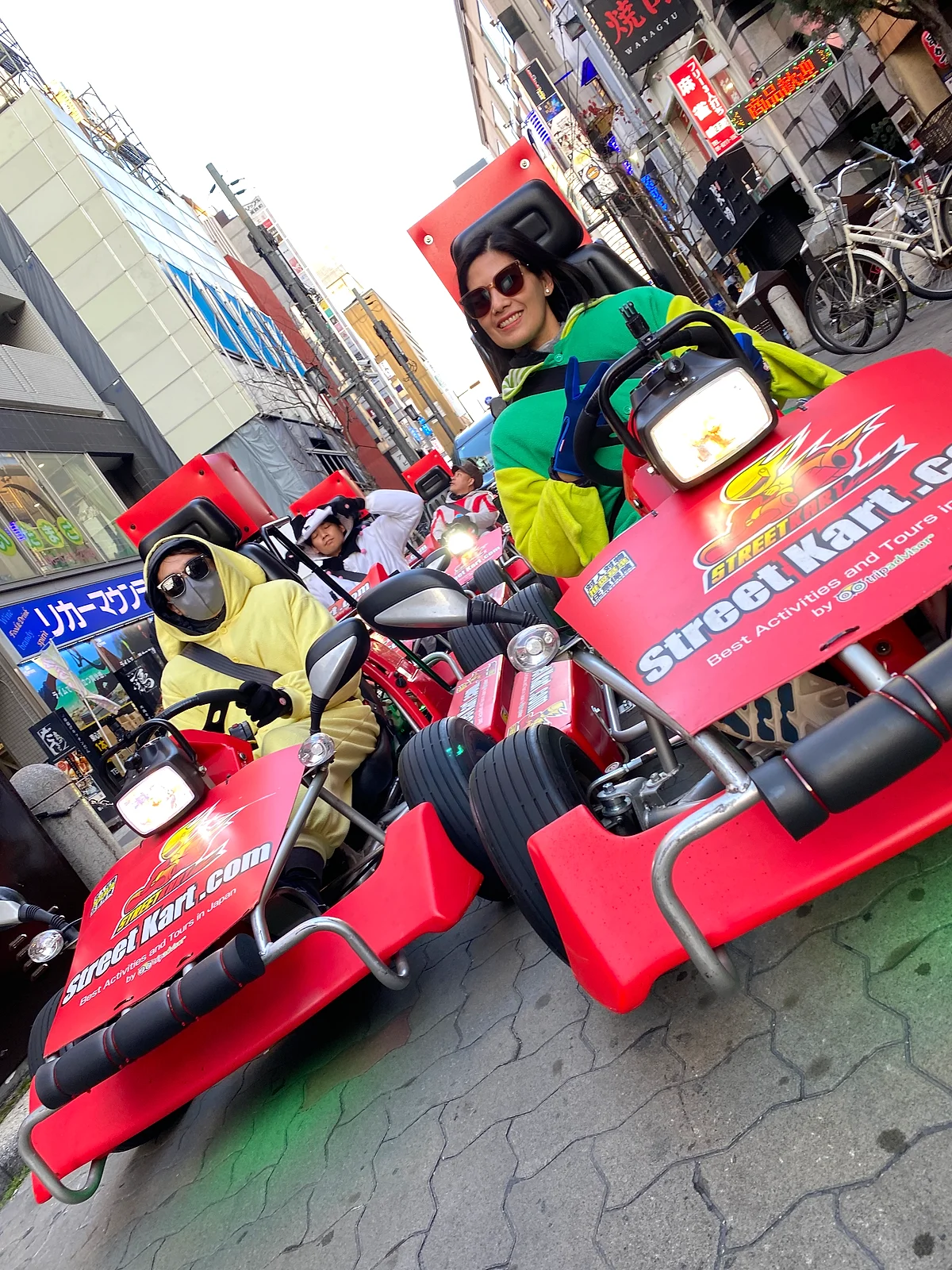
One group gets in Street Karts in Minami-Horie and heads out into the streets of Minami. The other group goes on foot and explores the backstreets of Horie and Amerikamura.
Splitting up is easy. "Okay, see you later" is all it takes. The hard part is deciding when to split and where to meet back up. And it turns out the answer depends a lot on whether it's still light out, the sun is going down, or it's already dark.
Why a Big Group in Osaka Can't Just Go "Everyone in Karts"
Let's get this out of the way first.
Street Karts are single-seaters. There's no passenger seat.
You can't split up by putting the friends who don't drive in the seat next to you. Show up on the day still believing that and you're in for a rough time.
There are license requirements for driving, and the rules differ depending on which country issued your license and what type it is. Who in your group can actually drive? Check this person by person before you leave. For the details, see the Street Kart official website. If you're standing in front of the shop without having sorted this out, someone ends up saying, "Wait, I can't ride?" Having someone hit that wall in the middle of the trip really stings.
One more thing. The tours are led by a guide, and each shop has set courses. How many people can ride together, and whether a big group can all fit into the same tour slot, are things to check on the official website. Even if five people want to drive, there's no guarantee all five will get the same slot. It's best to go in assuming that.
So change your mindset. Instead of "everyone has the same experience," go with "everyone has different experiences on the same day and shares them afterward." That way, availability won't throw you off.
Think of a surf lineup. Nobody tries to get ten people onto the same wave. You spread out and take turns, and that's how everyone gets to have fun. Traveling Osaka with a big group of friends works the same way. Splitting into a "driving crew" and a "walking crew" isn't a compromise. It's just one way to put the day together. If lots of people want to drive, split the driving crew across different slots too.
Once you see it that way, the question that suddenly matters is: what time of day do you split up?
Also, license status doesn't have to be the only thing deciding the groups.
Someone who rode a kart last time can walk this time and give their seat to a friend who hasn't ridden yet. And someone who spent their whole day shopping last time can drive this time. That kind of swap is something only a returning group can do. Everyone gets an Osaka that's different from last time.
When you decide, be honest about your energy and mood, too. If you've been walking since morning and your legs are heavy, you don't have to force yourself into the walking crew. You could also rest at the hotel before your kart tour. No need to hold back.
Splitting Up in Daylight: When the Walking Crew Can Venture Farther
In a word, the strength of daylight is visibility.
You can recognize faces from far away. Signs and maps are easy to read. So the walking crew can go a bit farther afield.
From the Minami-Horie shop by train, Kuromon Market is about 10 minutes away. Abeno Harukas is about 15 minutes. Even Osaka Castle is only about 20 minutes. Did you do a food crawl in Dotonbori last time? Then this time, snack on seafood at Kuromon Market instead. That kind of swap works well.
But here's the catch. The farther you go, the shakier your estimate for getting back.
Check how long the tour runs when you book. Then add travel time and a little buffer, and set your meeting time. The order matters: first the tour length, then pick the walking crew's destination to fit it. Don't do it the other way around.
If you're staying close by, Minami-Horie itself becomes the destination.
The streets lined with shops and cafes have a calm feel, one step removed from the hustle of Minami. You look at clothes through shop windows and stop when the smell of coffee pulls you in. It's a neighborhood made for that kind of wandering. The Yotsubashi side is about a 5-minute walk away. Amerikamura is about 5 minutes on foot, too. Peek into one vintage shop, then the next, and the time just melts away.
If you want more of a city shopping experience, Shinsaibashi-suji Shopping Street and Daimaru Shinsaibashi are about a 15-minute walk away. The covered arcade also works as a waiting spot on days with harsh sun or light rain. It's fine if the walking crew splits again into a "shopping group" and a "wait at a cafe group." In daylight, it's hard to lose track of each other.
One tip for the photographers.
In daylight, Horie's buildings cast sharp shadows. Rather than shooting straight on, try standing where you catch the light coming diagonally down the street from the side. The colors of the storefronts are less likely to blow out to white. It's the same thinking as surf photography, where you move to the side of the wave to avoid backlight.
Daylight has its perks for the driving crew, too.
Most people picture Dotonbori with its neon at night. Now picture driving through Dotonbori in broad daylight. Every letter on every sign and every detail of the buildings jumps out at you. It's the same place, but it'll look like a different city. The more times you've visited, the more this "familiar place at an unfamiliar time" hits home.
If lots of people want to drive and you're splitting them across slots, daylight is also when logistics are easiest.
The people who drove first can see off friends in the next slot near the shop, then go join the walking crew. Members rotate in and out and gradually spread across the city, ebbing and flowing like the tide.
Make Sankaku Koen (Triangle Park) in Amerikamura your meeting point and it's easy to follow. The name alone tells everyone where to go. "Triangle Park!" and everyone gets it. That's a big plus.
As the Sun Goes Down: Decide the Meeting Point Before You Split
The time a group is most likely to fall apart is actually dusk.
Several things pile up at once.
Shinsaibashi and Dotonbori keep getting more crowded. The city lights start coming on, and the signs you used as landmarks during the day take on a different look. And it's also when the phones you've been using since morning start running low on battery.
"I'll message you when I get there" usually stops working right around this time.
This is where it helps to pick one person as the point of contact.
In the walking crew, choose one person who has a portable battery and knows everyone's contact info. When the driving crew gets in touch, that person passes it on to everyone in the walking crew. When you form a hiking party, you assign a leader and someone to bring up the rear, right? Same idea. Having just one role assigned keeps a scattered group connected by a single line.
On top of that, decide the meeting place and time before you split.
And have everyone say it out loud once. Don't be shy about it. It really works.
Decide two things: your first choice, and a backup for when you can't reach each other. For example, make Triangle Park your first choice and Nishi-Ohashi Station, the closest station to the shop, your backup. Nishi-Ohashi Station is about a 3-minute walk from the shop. Even friends who don't know the area will understand a station name.
One more thing. Dusk shifts with the seasons.
In summer, it's late. In winter, it's early. Even if you pick the same "evening slot," whether you start driving in daylight or it gets dark partway through depends on the season. Just as you'd check a tide table before going into the ocean, check that day's sunset time before setting your meeting time. That alone cuts down on misjudgments.
Prices vary by season and time of day, so check the official website (kart.st) for current pricing. It's worth a look before you decide what time to drive.
A quick word on clothing, too.
Once the sun goes down, it feels a lot colder. The walking crew should bring an extra layer. The driving crew should bring one more on top of that, since they'll be riding into the wind. Even in central Osaka, it gets chillier than you'd expect along the river after dark. There's almost always one person who let the daytime heat fool them and came out in just a T-shirt.
After Dark: Set Up a "Stay-Put Group" Under the Neon
Minami at night is not a good place to go looking for friends you split up from.
The neon of Dotonbori is fun no matter how many times you see it. Red and yellow lights ripple on the river, and the whole area hums with noise. But what happens when the crowds get thick? A group of ten-plus just standing in one spot gets in everyone's way. And spotting a few latecomers in the crowd is a real chore.
So if you split up at night, set up a "stay-put group" within the walking crew.
Their job is to go into a restaurant first, hold the seats, and wait for the driving crew to arrive.
You could have okonomiyaki at Chibo, about a 10-minute walk from the shop. Or enjoy a quiet drink at Hozenji Yokocho, about 20 minutes on foot. Those are a couple of options. If you're going in with a big group, it's a good idea to contact the restaurant ahead of time about seating.
This way, the meeting point is a restaurant, not a person. Even in the dark and in crowds, nobody gets lost.
The driving crew shouldn't forget the walk from the shop to the meeting spot, either. Hozenji Yokocho is about 20 minutes on foot. Make sure to factor in the time to walk over after the tour ends.
And here's the fun part.
As you walk through Minami at night toward the meeting spot, you end up seeing the streets you just drove through again, this time at walking speed. "Oh, that's the corner we turned at earlier." Comparing notes like that is surprisingly good.
For photographers in the walking crew, try shooting the neon reflected on the surface of the Dotonbori River. The calmer the night, the cleaner the reflections. But setting up a tripod on a crowded bridge is a nuisance to everyone around you. Resting your camera on the railing and using it for support works just fine.
And there's one rule you can't skip when splitting up at night.
The driving crew doesn't drink until they're done driving.
Even if the walking crew has already started toasting, hold off. Even if you can hear glasses clinking, hold off. Once the driving crew joins, everyone toasts again together. With the tour stories to go with the drinks, that's bound to be the livelier toast.
Check the official website before booking to see whether there are tours in the evening and when they start.
What Makes Street Kart Special: Why the Walking Crew Will Want to Hear All About It
Back at the table, the walking crew leans in, eager to hear the driving crew's stories.
Why does that happen? Here are a few reasons.
First, the vehicle itself. Your eye level drops way down. The signs and buildings you'd normally look up at feel even farther overhead. The sounds and smells of the city hit you directly. It's close to that low feeling of looking back at the shore from your board while waiting for a wave. It's the same street you'd walk down, but you'll feel like a shrunken version of yourself driving through a city of giants.
Next, the areas the Osaka course covers. Starting from Minami-Horie, it runs through Amerikamura, Shinsaibashi, Dotonbori, and Namba. The big names of Minami are all on the route.
The places the walking crew walked during the day, the driving crew passed through at a different height and speed. That's why at the table that night the conversation clicks: "Did you see that corner?" "Yeah, I saw it!" You've traced the same city in different ways.
Three Things for Your Group to Decide Before Booking
First: who's driving.
Have each person check the license requirements on the official website. It's fine if some people can't drive or decide not to. That just means more fun for the walking crew. Don't push it. Go at your own pace.
Second: what time of day you'll split up.
In daylight, the walking crew goes farther. At dusk, set two meeting points. At night, set up a "stay-put group," and the driving crew holds off on toasting. Decide which of these three patterns you're going with ahead of time and you'll waste a lot less time deciding on the day.
If you can't decide, the fastest way is to work backward from whatever group plans are non-negotiable.
If you want everyone to have dinner together at night, the driving crew looks for open slots in daylight or at dusk, and everyone spends the night together. On the other hand, if you want the whole group to visit Osaka Castle during the day, split up from the evening onward.
Set the time when everyone will be together first. Then fit the split-up time around it. That keeps the plan tidy.
Third: when to book.
Weekends tend to fill up, so booking early is recommended. That goes double if a big group is splitting across slots. See the official website for booking details.
Check on language before you book, too. Guidance on tour day is basically in English. Whether guidance is available in Japanese or other languages depends on the staff that day, so don't count on it too much. The official website supports 22 languages, but that's separate from the guidance on tour day, so keep the two straight.
Also, take any trash from your waiting time home with you. At the beach or in the city, leave it cleaner than you found it. You'll feel better heading to your next stop.
Now, picture this.
The friends who split into two groups gather around the same table again at night. The driving crew brings stories of the wind on their faces. The walking crew brings stories of the shop they found at the end of an alley. You came to the same Osaka and saw different Osakas. And from there, conversations start that you never had on your last trip.
For availability and the latest details, see the Street Kart official website.
Start by deciding within your group who's going to drive.
So, who's raising their hand?
This article was originally written in Japanese and translated using AI. Some expressions may read unnaturally, and we appreciate your understanding. For the most accurate and up-to-date information, please refer to the official site at kart.st.
Street Kart is not affiliated with Nintendo or the Mario Kart series in any way. We do not provide costumes of Nintendo characters, and such costumes may not be worn during tours even if brought by participants.