
Nervous About English-Language Guidance? 5 Steps to Prepare Before Riding a Street Kart in Minamihorie, Osaka
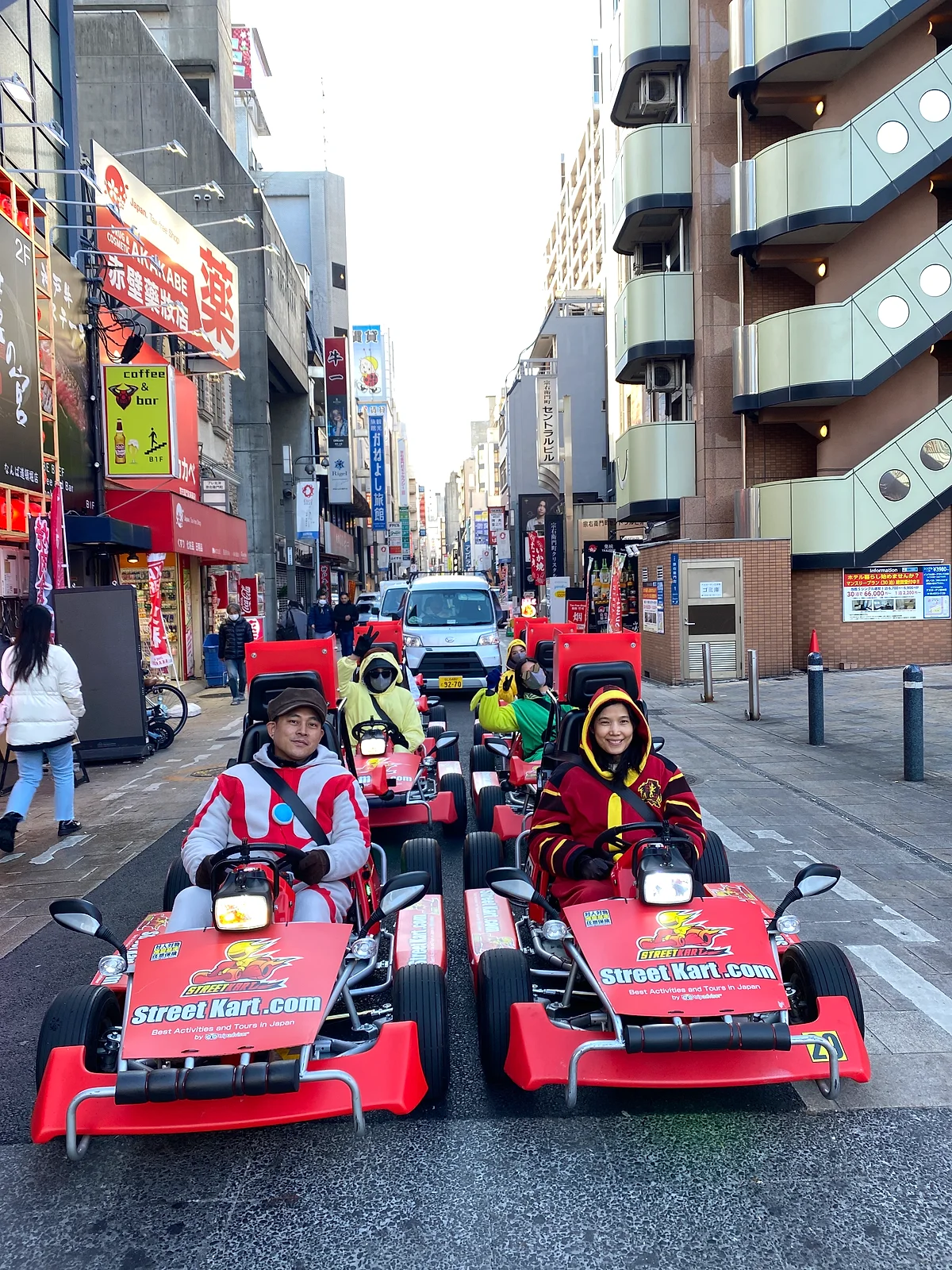
Nervous About English-Language Guidance? 5 Steps to Prepare Before Riding a Street Kart in Minamihorie, Osaka
The neon lights of Dotonbori. The steam rising from takoyaki. You've already seen both.
This is your second or third trip to Osaka. You think, "Next time, I want to take the wheel myself and drive around Minami." When you think about it, though, what holds you back may be the language more than the driving.
On the day of a Street Kart tour, guidance is basically given in English.
For people who aren't confident in English, this is often the point where they stop before booking. I get it. But let me be clear: language anxiety isn't something you push through on the day. It's something you shrink ahead of time. If you deal with it step by step, you won't be straining to catch every word on the day, and you can enjoy the feel of the city instead.
First, the basics. Guidance on tour day is basically in English. Whether guidance is available in Japanese or other languages depends on the staff working that day. If you show up expecting guidance in your native language, you'll be thrown on the day. On the other hand, if you know English is the default, you can focus your preparation. In some countries you can get by in English everywhere, but in Japan there are many situations where you can't. If you've traveled in Japan before, you already know that feeling.
Below, I'll walk you, a first-time Street Kart rider, through five steps, from before you book to after you finish driving. Let's go.
Step 1: Read the official website, which supports 22 languages, in a language you can read comfortably
The Street Kart website is available in 22 languages. This is where preparation starts.
Participation requirements, things to note on the day, frequently asked questions: the more detailed the information, the easier it is to misread in an unfamiliar language. So first, pick the supported language you read most easily and switch the site to it. There's no rush. Take your time reading through it.
One important point: the website's language and the language used on the day are two separate things. Being able to read the site in a comfortable language doesn't mean the on-site guidance will be in that language too. So treat what you read on the site as a "draft" of what you'll hear in English on the day. Once you've grasped the content in a language you can read, you'll be surprised how much you catch when you hear it in English.
Think of a surfing lesson. If you hear how to move on land first, your body follows along even when short English instructions come at you in the water. It's the same here.
Two things are especially worth reading ahead of time: what to wear and what happens on rainy days. Street Kart's guidance recommends closed-toe shoes such as sneakers, and says to avoid sandals, heels, skirts, and dresses. For rain, tours go ahead as planned in light to moderate rain with raincoats provided, and are canceled in heavy rain or typhoons. Imagine hearing these things for the first time, in English, at check-in on the day. You won't have time to go back to your hotel and change. Check the latest policies on the official website and use them when you get ready to head out.
While reading, write down anything that confuses you right away. "What does this sentence mean?" "How does this apply to me?" Small questions are fine. Collecting them will pay off in the next step. If you're booking with friends, have everyone complete this step. That way, no one has to go around translating the explanation for the whole group on the day.
Step 2: Clear up your questions in writing during the booking exchange
Booking inquiries are accepted via Facebook, LINE, and email. Check the official website for contact details.
This is good news for anyone anxious about language. In writing, you can put your sentences together at your own pace. You can calmly check the replies with a translation tool. You don't have to panic about missing what someone said.
Ask all the questions you collected in Step 1 here at once. It can also help to say upfront, honestly, that you're not confident in English. If you'd like guidance in a language other than English, ask about it in advance. Keep in mind, though, that guidance in Japanese or other languages depends on the staff that day, so it can't be promised. That's why I recommend asking this: "What should I know in advance so I won't have trouble with English-language guidance?" I think you're more likely to get a useful answer that way.
A few tips on writing your messages. Write one question per line, numbered and short. "1. What happens if it rains?" "2. What should I bring on the day?" This is easier for the other side to answer than one long paragraph, and easier for you to see which answer goes with which question. If you use a translation tool, translate the English back into your own language. If the meaning has shifted, break the sentence into shorter parts and rewrite it. That alone cuts down misunderstandings a lot. Save the replies as screenshots. If you get stuck for words at check-in, showing that screen will speed things up.
One more thing: weekends tend to fill up. Expect a few rounds of back-and-forth, and get in touch early once your dates are set. If you plan for waiting time from the start, you'll also have time to think your messages through.
Step 3: Treat your driver's license check as a "language issue" and handle it early
The driver's license is easy to overlook.
Street karts drive on public roads, so you need a valid driver's license that allows you to drive a car. What you need depends on the country that issued your license and the type of license. I don't want to list only some cases here and give you the wrong idea. Be sure to check the driver's license information on the Street Kart official website to see what applies to you. Please refer to the official website for details.
Why did I put this under language? Because paperwork is exactly where the language barrier hits hardest. Going back and forth in English at check-in about "Is this document enough?" makes even people used to English nervous. Confirm anything you're unsure about beforehand through the written exchange in Step 2. That alone takes away one reason to panic on the day.
Also, don't decide on your own that "a photo on my phone should be fine." Which forms are accepted is also something to check in the official website's guidance. Don't assume. Prepare according to what you've confirmed. This is the surest way to avoid an English back-and-forth at the check-in desk.
Don't bury your documents at the bottom of your bag. Before you leave, put them where you can pull them out right away. Sometimes showing a document gets the point across faster than explaining.
Step 4: On the day, "watch and follow" instead of trying to catch every word
Now it's the day itself.
The mindset is simple. You don't need to catch every single word of English. Street Kart tours are led by trained guides. While driving, your job is to follow the guide in front of you while watching your surroundings and following Japanese traffic rules.
Knowing the day's flow ahead of time makes listening much easier. When you arrive at the shop, there's check-in, a driver's license check, a safety briefing, an explanation of how to operate the kart, and then an explanation of the route and things to watch for. Things generally go in roughly that order. If you know the order, you can listen while guessing what they're talking about at each moment. For the operating explanation, you'll hear "brake" and "accelerator"; for the route, "left," "right," and "stop." Just saying likely words out loud beforehand gets your ears ready. Japan drives on the left. If you come from a country that drives on the right, pay extra attention whenever you hear the word "left."
That said, you want to listen carefully to the briefing before setting off. If you're anxious, make sure these two phrases come out of your mouth right away:
"Sorry, could you say that again?" "Slowly, please."
The worst thing you can do is nod along without understanding. Asking again isn't embarrassing. It's a safety measure. In surfing, too, the most dangerous person is the one who paddles out without understanding. Same thing.
If you want to check the controls after the explanation, try moving your hands and asking "Like this?" Even if your words fall short, showing the motion gets the message across.
There are spots along the tour where you stop for photos. If something comes up while driving, you can ask when you stop. There's no need to shout questions while driving. Instead, focus on the guide ahead and on Japanese traffic rules while you're on the road.
If you use a translation app, use it only until check-in is done. Don't touch your phone while driving. If you have attention to spare for a screen, put it on the guide ahead and the cars around you instead. Prepare in advance. Once you set off, keep your eyes and ears on the road. The more anxious you are about language, the more this order matters.
Step 5: Getting to Minamihorie, and what to do after your drive
The Osaka shop is in Minamihorie.
The shop has no parking, so use public transportation. The nearest station is Nishi-Ohashi Station on the Osaka Metro Nagahori Tsurumi-ryokuchi Line, a 3-minute walk away. It's also a 5-minute walk from Yotsubashi Station on the Yotsubashi Line. Note the station names in romaji too. It makes searching in a map app easier.
Arriving with time to spare is also part of language prep. If you rush in at the last minute, you won't have the calm to listen to the English at check-in. Get there a little early and take a short walk around the streets of Minamihorie. It'll help you relax, mentally and physically.
Think about your luggage as well. The shop has lockers for small items, but they're not suitable for large bags like suitcases. If you're riding on the day you check out of your hotel, ask about large luggage during the Step 2 exchange for peace of mind. That's one less thing to discuss in English at check-in.
Let's talk about the course too. Landmarks listed for the Osaka shop's route include the streets of Minamihorie and the Yotsubashi/Horie area, Amerikamura with its rows of vintage clothing shops, Shinsaibashi, and the very heart of Minami: Dotonbori and Namba.
Last time, you walked these streets. This time, you'll drive through them. Dotonbori, with the Glico sign in view, will probably look different from when you were on foot. Driving a kart, the wind, the sounds of the city, and the buzz of Dotonbori rush in without needing any words. That's how it feels to me. Whether or not you understand English, the energy of Minami comes straight through.
After the drive, you return to the shop and hand back the kart. From there, your time is your own. After driving, explore on foot. Amerikamura is a 5-minute walk from the shop. Vintage clothing and streetwear shops are clustered around Triangle Park (Sankaku Koen). Walking slowly through streets you just drove past is a lot of fun. If you want to see a calmer side of Osaka, head to Hozenji Yokocho, about a 20-minute walk away. It's an alley lined with kappo and Japanese restaurants, with a character quite different from the bustle of Dotonbori.
Amerikamura is also on the Osaka shop's driving route. Hozenji Yokocho is an option for before or after your tour. And if you plan to snack as you stroll, carrying a small bag is handy so you can take your trash with you.
Street Kart's appeal from the perspective of someone anxious about language
Looking at it from the angle of language anxiety, Street Kart has several features that make it easy to start preparing.
First, its track record. As of November 2023, across all shops combined, there had been over 150,000 tours, over 1.34 million customers, and over 20,000 reviews, with an average rating of 4.9/5.0. That's one thing to weigh before you book for the first time.
Next, there are 9 shops nationwide (7 in Tokyo, 1 in Osaka, 1 in Okinawa). If you rode in Tokyo on a previous trip, this time you can drive a different city in Osaka with the same tour flow. If you've been through the flow once, your language anxiety will probably be smaller than before.
Start today with Step 1
From checking things before booking to handling the day itself, knowing the flow lets you prepare in advance.
There's only one thing to do today: open the official website in a supported language you can read, and note anything that catches your attention. Once that's done, send your first message via Facebook, LINE, or email. Weekends tend to fill up. If you already know when you want to go, move early.
It's fine if you can't speak English well. If you prepare, you'll be able to say "One more time, please." That's enough.
From Minamihorie into Minami: an Osaka different from last time is waiting for you. Now, go take the wheel!
This article was originally written in Japanese and translated using AI. Some expressions may read unnaturally, and we appreciate your understanding. For the most accurate and up-to-date information, please refer to the official site at kart.st.
Street Kart is not affiliated with Nintendo or the Mario Kart series in any way. We do not provide costumes of Nintendo characters, and such costumes may not be worn during tours even if brought by participants.